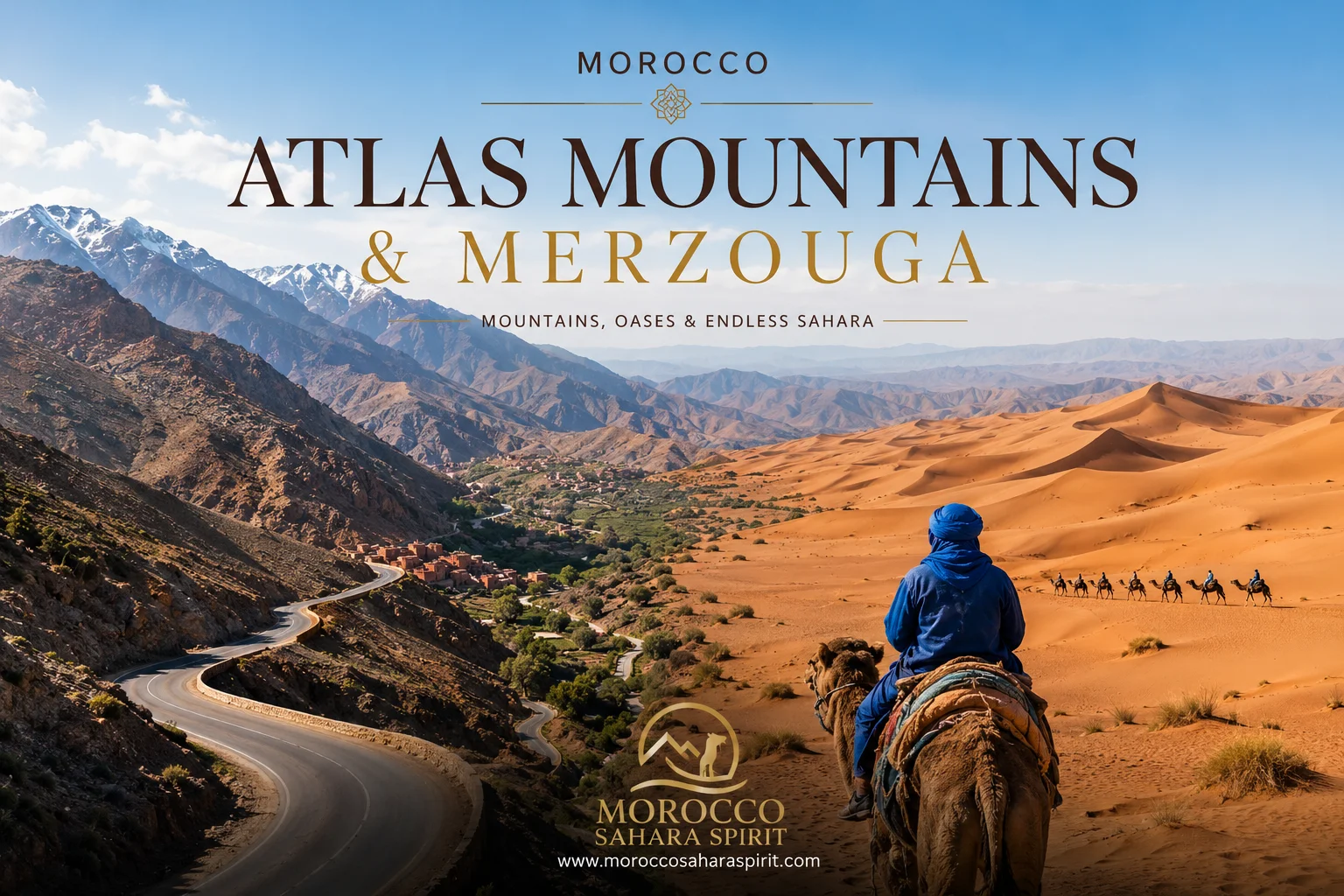
Six days is the point where a Morocco trip stops being a dash to the dunes and back. It is long enough to cross the High Atlas properly, spend two nights in the Sahara rather than one, and return through the mountains instead of enduring a single nine-hour drive at the end. This is the full itinerary, with real driving distances, what each day costs you in the car, and an honest answer to whether six days is enough.
Why Choose a 6-Day Morocco Atlas Mountains and Merzouga Itinerary?
Marrakech to Merzouga is roughly 560 kilometres in each direction, about nine and a half hours of driving. Everything about a Morocco desert itinerary follows from that number.
On a three-day tour, two of the three days are driving days. You arrive at the dunes in the late afternoon, sleep there, and leave after sunrise. It works, and for many travellers it is the right trade, but the Atlas Mountains are something you look at through a window.
A four-day tour adds a second desert night and a free day at Merzouga. That is the single biggest improvement available for one extra day.
Six days changes the shape of the trip rather than just its length. You get the second desert night and the free day, and the return journey splits across two days through Telouet and the Imlil valley. The mountains become a destination instead of a commute, and no single day involves more than about six hours in the vehicle.
Most six-day itineraries published online do not do this. They drive out over three days and come back in one, which means finishing the week with eight to ten hours on the road. It is the most common weakness in the format.
Overview of the 6-Day Morocco Itinerary
| Day | Route | Driving | Overnight |
|---|---|---|---|
| 1 | Marrakech → Tizi n’Tichka → Ait Ben Haddou → Dades Valley | about 320 km, 6 h | Dades Valley |
| 2 | Dades → Todra Gorge → Erfoud → Merzouga | about 260 km, 4 h | Desert camp, Erg Chebbi |
| 3 | Free day at Merzouga: sunrise, Khamlia, the erg | local 4×4 only | Desert camp, Erg Chebbi |
| 4 | Merzouga → Rissani → N’Kob → Draa Valley → Ouarzazate | about 370 km, 6 h | Ouarzazate |
| 5 | Ouarzazate → Telouet Kasbah → Imlil | about 220 km, 4 h 30 | Imlil, High Atlas |
| 6 | Walk in the Imlil valley → Marrakech | about 65 km, 1 h 30 | Tour ends |
Total driving is roughly 1,235 kilometres over six days, with one day entirely free of road travel.
Day-by-Day Morocco Atlas Mountains and Merzouga Itinerary
Day 1: Marrakech to the Dades Valley over the Tizi n’Tichka
You leave Marrakech after breakfast and climb almost immediately. The Tizi n’Tichka carries the road over the High Atlas at around 2,260 metres, and the change on the far side is abrupt: green valleys give way to red earth, then to bare stone.
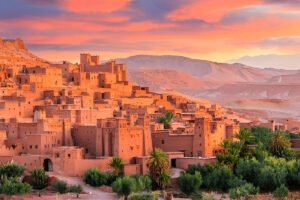
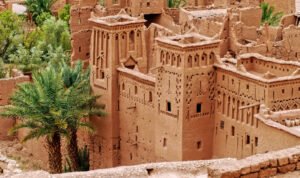
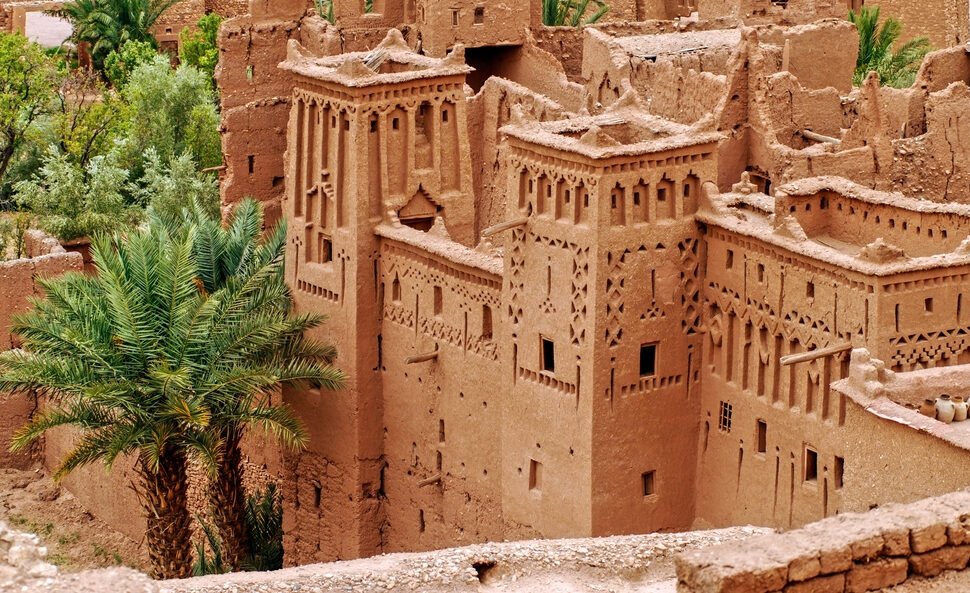
The first proper stop is Ait Ben Haddou, the fortified ksar on the old caravan route, UNESCO-listed since 1987. Allow an hour to walk up through it. Then Ouarzazate, and east into the Dades Valley, arriving in the late afternoon with enough light to see the gorges.
Day 2: Dades to Merzouga by way of the Todra Gorge
The shortest driving day until the last one. The Todra Gorge comes first: limestone walls around 400 metres high closing to roughly ten metres across at the floor, with a shallow river running through. You can walk into it in twenty minutes.
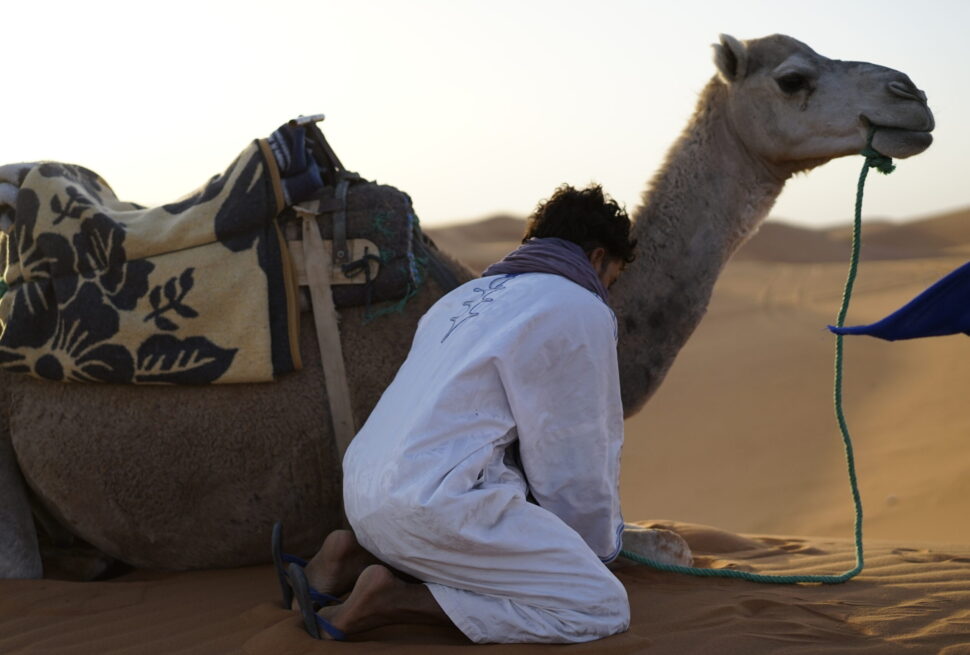
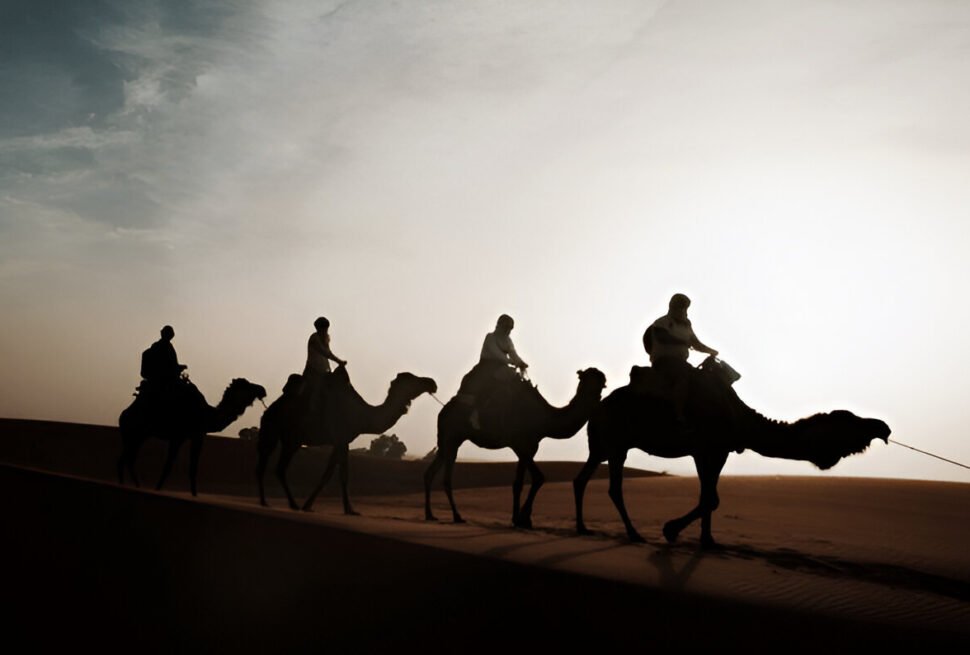
Then east through Tinejdad and Erfoud to the edge of Erg Chebbi. In the late afternoon you leave the vehicle and ride into the dunes by camel, about an hour, timed so that you arrive as the light goes. Dinner at the camp, and drums around the fire afterwards.
Day 3: A free day at Merzouga
This is the day that short tours do not have, and it is the reason to come for six.
Sunrise over the dunes first. After that the day is open. The usual choice is a 4×4 circuit through the erg: the village of Khamlia, where Gnaoua families play music descended from sub-Saharan Mali; a nomad family still living in the erg; the abandoned mines at Mfis; the kasbahs around Rissani, which was the capital of the region long before Merzouga existed. Sandboarding if you want it.
Or you can stay at the camp and do nothing at all, which is a perfectly defensible use of a day in the Sahara. A second camel ride at sunset, and a second night in the dunes.
Day 4: Merzouga to Ouarzazate through the Draa Valley
Westward out of the desert on the southern road through Rissani, Alnif and N’Kob, with the dark mass of the Jbel Saghro on your right for most of the morning. This is the emptiest driving of the week, and for many people the best of it.
In the afternoon the road meets the Draa Valley, a continuous palm oasis along Morocco’s longest river, before climbing to Ouarzazate for the night.
Day 5: Ouarzazate to Imlil by the old caravan road
Instead of returning on the main road, the route turns off onto the original caravan track and climbs to Telouet. The Glaoui kasbah here controlled the pass before the modern road existed, and it is half ruin and half intact painted ceilings. Very few tours stop.
From Telouet the road recrosses the Atlas and drops into the Imlil valley, below Jbel Toubkal, at 4,167 metres the highest peak in North Africa. The air is cooler and the walnut terraces are green even in winter.
Day 6: A walk in the High Atlas, then Marrakech
A guided walk from Imlil through the Berber villages and walnut groves on the lower slopes, two to three hours at an easy pace, no equipment or experience required. Then the short descent to Marrakech, arriving in the afternoon.
Discovering the High Atlas Mountains
The High Atlas runs for roughly 700 kilometres across Morocco and separates the Atlantic plains from the Sahara. It is the reason the country has both.
This itinerary crosses it three times and in three different ways: the Tizi n’Tichka on the modern road, the abandoned caravan route through Telouet, and the Imlil valley on foot. Villages here are built from the hillside they stand on, flat-roofed and the same colour as the rock, which is why you often do not see them until you are among them.
If the mountains are what draws you rather than the desert, our Atlas Mountains 3 Valleys day tour and the full-day trip to Imlil cover them as day trips from Marrakech.
Exploring Ait Ben Haddou and Ouarzazate
Ait Ben Haddou is a ksar: a fortified village of earthen buildings behind a defensive wall, built where the caravan route from the Sahara crossed the Ounila river. Trade in salt, gold and enslaved people passed through here for centuries. It has been a UNESCO World Heritage site since 1987, and the earth buildings are rebuilt continually because rain dissolves them.
Ouarzazate, half an hour further on, grew as a garrison town and is now the centre of Morocco’s film industry. Atlas Studios and the CLA studios are both here, and the Kasbah Taourirt in the town itself is worth the entrance fee.
We wrote more about the kasbah in four reasons to visit Ait Ben Haddou, and it is also available as a day trip from Marrakech if you are not going further south.
Discovering Dades Valley and Todra Gorges
The Dades and the Todra run parallel out of the same mountains and could not look less alike. The Dades is wide and farmed, with the famous switchback road climbing out of it and rock formations locally called the Monkey Fingers. The Todra is a slot: walls about 400 metres high, a floor sometimes only ten metres wide, and a cold river running along it. Climbers come for the limestone; everyone else walks in for half an hour and looks up.
Between them sits the Valley of Roses around Kelaat M’Gouna, where Damask roses are harvested in April and May and distilled into rose water. If you travel in those weeks, you will smell it before you see it.
Experiencing the Merzouga Sahara Desert
Erg Chebbi is a sand sea about 28 kilometres long and up to 5 kilometres wide, with dunes reaching roughly 150 metres. It is not the largest erg in Morocco — Erg Chegaga is wider — but it is the most accessible, and it is the one in the photographs.
Camel trekking takes about an hour between the edge of the erg and the camps, and is timed for sunset on the way in. Camels rise and sit in a lurch that catches people out; hold the front of the saddle.
The sunset is the moment most people come for, but sunrise is better and far quieter, because half the camp sleeps through it.
The camp is tents around a central area, with shared or private bathrooms depending on the standard. Dinner is tagine and bread, eaten together, followed by drums around the fire — Gnaoua rhythms, the same tradition you hear at Khamlia.
And there is the sky. Merzouga is far enough from any town that the Milky Way is plainly visible on a clear night. We described a night there in a night in a Sahara desert camp.
What Is Included in the 6-Day Morocco Desert Tour?
On our 6-day Atlas Mountains and Merzouga tour, the price covers:
- Private transport in an air-conditioned vehicle or 4×4 with a professional driver
- Five nights’ accommodation: Dades Valley, two nights at a desert camp at Erg Chebbi, Ouarzazate, and the Imlil valley
- Daily breakfast, and dinner at every overnight stop including both desert nights
- Camel trek at Erg Chebbi on arrival and again at sunset on the free day
- A guided walk in the Imlil valley on the final morning
- Pick-up and drop-off at your accommodation or the airport in Marrakech
- All taxes and fuel charges
What Is Not Included?
- Flights, international or domestic
- Lunches and drinks
- Monument and site entrance fees, including Ait Ben Haddou and Telouet
- The 4×4 circuit at Merzouga and sandboarding, if you add them
- Travel insurance
- Tips for the driver, guides and camp staff — optional but appreciated
- Personal expenses
Two points worth making plainly, because most competing itineraries leave them out. Cancellation is free up to 15 days before departure, with any deposit returned in full. And there is no card payment on this website: a deposit confirms the booking and the balance is paid during the trip.
Best Time to Visit the Atlas Mountains and Merzouga
March to May and late September to November are the best windows. Comfortable desert days, tolerable nights, and the mountains are clear. The Valley of Roses harvest falls in April and May.
June to August is hot in the south — daytime temperatures in the desert regularly exceed 40 °C. The trip still runs, with activities moved to early morning and evening, but it is not the comfortable version.
December to February gives you pleasant days and genuinely cold nights; January lows at Merzouga average around 3.5 °C. Snow can close the Tizi n’Tichka for short periods, in which case the route reroutes or the days reorder. Almost no competing itinerary mentions this, and it is worth knowing before you book a winter trip.
Our month-by-month guide to the best time to visit the Moroccan Sahara has the full breakdown.
What to Pack for Your Morocco Desert Adventure
- Layers. The swing between an afternoon on the dunes and three in the morning in a tent is larger than anything you pack for at home.
- A fleece or warm jacket for the desert nights and the Imlil valley, in every season.
- Closed walking shoes for the gorges and the Imlil walk, plus sandals you do not mind filling with sand.
- A scarf. Shoulders, head, sand, cold. The single most useful item.
- Cash in dirhams. Card machines become scarce south of Ouarzazate.
- A power bank. Desert camps have limited electricity, often only in the evening.
- Sun protection and a refillable water bottle.
The tested list is in what to pack for the Sahara desert in Morocco, and what to wear in Morocco covers the cultural side.
Is Six Days Enough to Explore Morocco’s Atlas Mountains and Sahara?
For the Atlas and the Sahara specifically, yes. Six days covers the southern route properly with two desert nights, three crossings of the mountains and one day with no driving at all.
For Morocco, no — and no honest itinerary will tell you otherwise. Six days from Marrakech does not include Fes, Chefchaouen, Meknes, Volubilis or the Atlantic coast. Reaching those means seven days at minimum and comfortably ten. If that is what you want, the 7-day tour adds the imperial cities, and we worked through the trade-offs in how many days you actually need in Morocco.
The trade-off six days makes is depth over breadth. You see one region thoroughly instead of four regions through a windscreen.
3-Day vs 6-Day Merzouga Desert Tour: Which Should You Choose?
This is the decision most travellers are actually making, so here it is side by side.
| 3-day Merzouga tour | 6-day Atlas & Merzouga | |
|---|---|---|
| Driving | About 1,120 km over 3 days. Two of the three are driving days. | About 1,235 km over 6 days. No day exceeds roughly 6 hours; one has none. |
| Nights in the desert | One | Two |
| Free time at Merzouga | Sunset, night, sunrise, then leave | A full day: 4×4 in the erg, Khamlia, nomad families, or nothing at all |
| Atlas Mountains | Crossed by road, not visited | Three crossings, plus Telouet and a night and a walk at Imlil |
| Return journey | One long day back to Marrakech | Split over two days through the mountains |
| Price per person | From €110 | From €850 |
| Suits | Short stays, tight budgets, travellers who want to see the dunes and are content with that | Travellers with a week, walkers, families, anyone who does not want the trip to be mostly driving |
The price gap is large because the products are different: the three-day runs as a shared group departure, while the six-day is private, with five nights of accommodation and most meals.
If your trip is short, take the 3-day Marrakech to Merzouga desert tour without hesitation — it is the most booked desert itinerary in Morocco for good reason. If you can find a fourth day, the 4-day version adds the second desert night, which is the biggest single upgrade available. The jump to six days is for people who want the mountains as well as the sand. We compared the shorter options in detail in Merzouga vs Zagora vs Erg Chegaga.
Book Your Morocco Atlas Mountains and Merzouga Adventure
We are a local team based in Marrakech. You deal with the people running your tour, not a platform taking a commission, and the itinerary on this page is a starting point rather than a fixed package — the free day can become something else, nights can be added anywhere, and the route can start or finish in Fes if that suits your flights better.
The 6-day Atlas Mountains and Merzouga Desert Adventure runs from €850 per person as a private tour, with free cancellation up to 15 days before departure.
Send us your dates and we will come back with a route and a price. Tell us what you want to see, or message us on WhatsApp if that is quicker.
Frequently Asked Questions
How many days do you need from Marrakech to Merzouga?
Three at an absolute minimum. Merzouga is about 560 km from Marrakech, roughly nine and a half hours of driving each way, so a two-day trip means around nineteen hours in a vehicle for one night in the dunes. Three days is the honest floor, four is comfortable, six makes the mountains part of the trip.
Is a six-day Morocco itinerary enough?
Enough for the Atlas and the Sahara, comfortably. Not enough for Morocco as a whole — Fes, Chefchaouen and the coast need seven days or more.
Is the Sahara Desert worth visiting?
Yes, provided you reach the real dunes. Erg Chebbi at Merzouga and Erg Chegaga are sand seas; Agafay, 30 minutes from Marrakech and often marketed as a desert, is stony hills with no dunes at all. It is a fine evening out, but it is not the Sahara.
How long is the drive from Marrakech to Merzouga?
About 560 km and nine and a half hours, over the Tizi n’Tichka pass and through Ouarzazate and the gorges. On this itinerary it is split across two days.
Is camel trekking included?
Yes — twice. Once riding into the camp on arrival at Erg Chebbi, and again at sunset on the free day. If anyone would rather not ride, we can bring you to the camp by 4×4 instead.
What is the best month to visit Merzouga?
April, May, October and November. Summer exceeds 40 °C in the south; January nights at Merzouga average around 3.5 °C.
Can you visit the Atlas Mountains and the Sahara on one trip?
Yes, and the road to Merzouga crosses the Atlas regardless. The question is whether you stop. On this route you cross the mountains three times and spend a night and a morning in the Imlil valley.
What should you wear in the desert?
Loose, long and light by day; a fleece and long trousers after sunset in any season. Closed shoes for the drive and the gorges. A scarf for the sand.
Is the tour suitable for families?
Yes, and six days suits families better than three, because the free day removes an early start and the driving is spread out. Tell us your children’s ages and we will be honest about fit — see Morocco desert tours with kids.
Can the tour be organised privately?
It is private by default: your party, your vehicle, your dates. A small shared group version is available on request, and the private itinerary can be changed in any way you like.