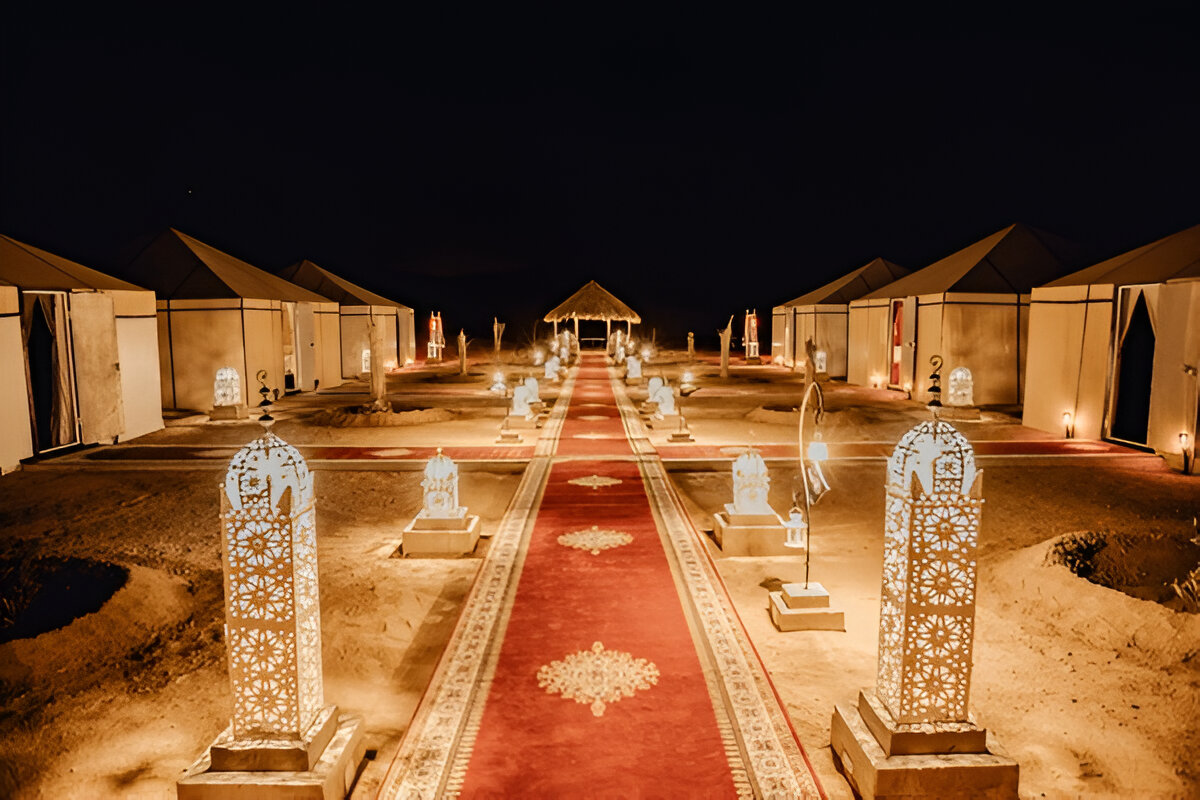
Almost every Morocco desert tour ends with the same line in the itinerary: overnight in a desert camp. It tells you nothing about what the night is actually like. This is what to expect, hour by hour, and what to check before you book — because “desert camp” covers everything from a canvas tent with a mattress to a suite with a proper bathroom.
The short answer
You arrive by camel at dusk, eat dinner in a communal tent, sit outside around a fire while someone plays drums, sleep under heavy blankets in a canvas tent with no mains electricity, and get up before dawn to watch the sun come over the dunes. It is cold at night for most of the year, the bathroom situation is simpler than a hotel, and almost nobody regrets doing it.
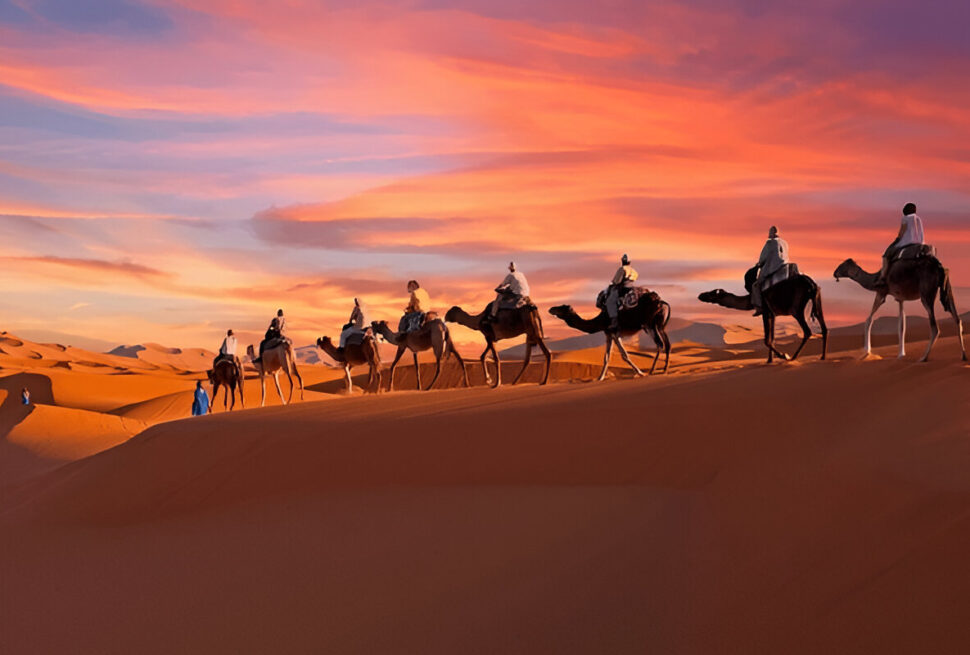
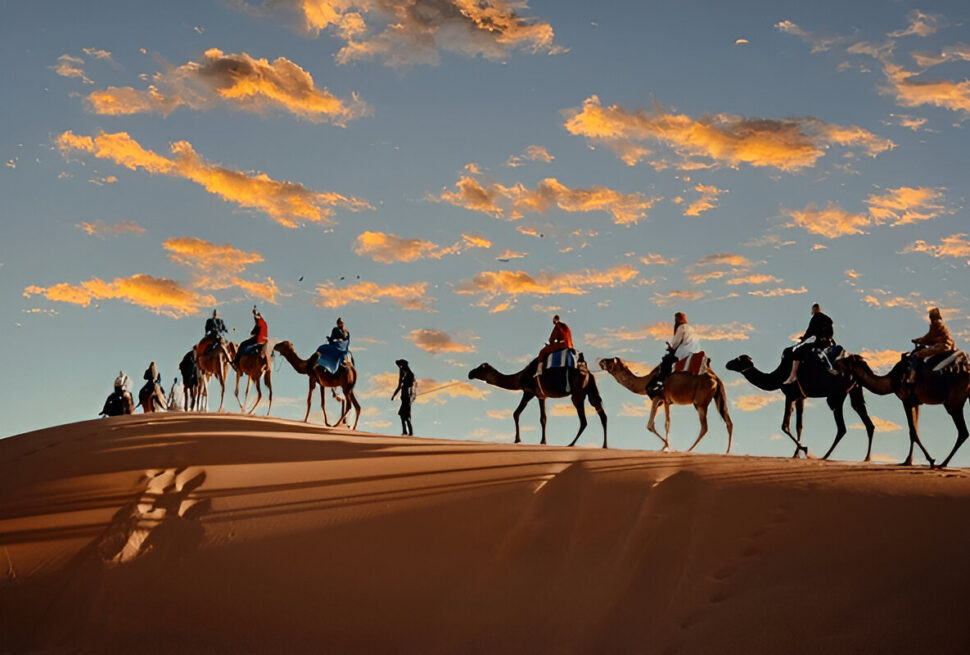
Arriving: the camel trek
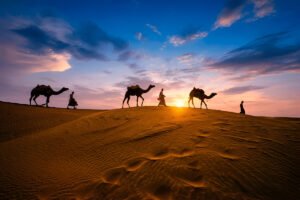
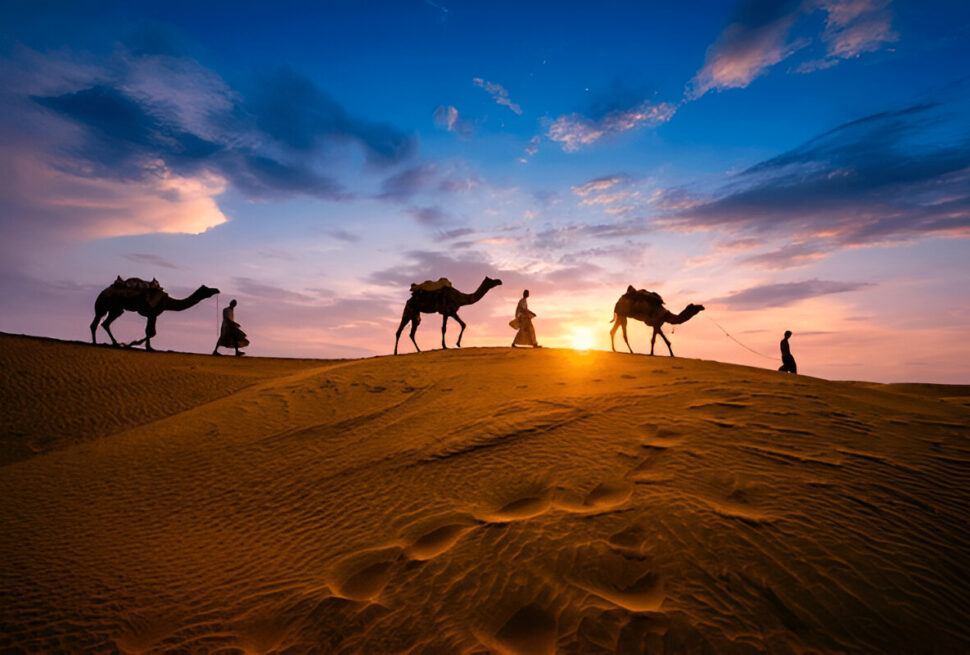
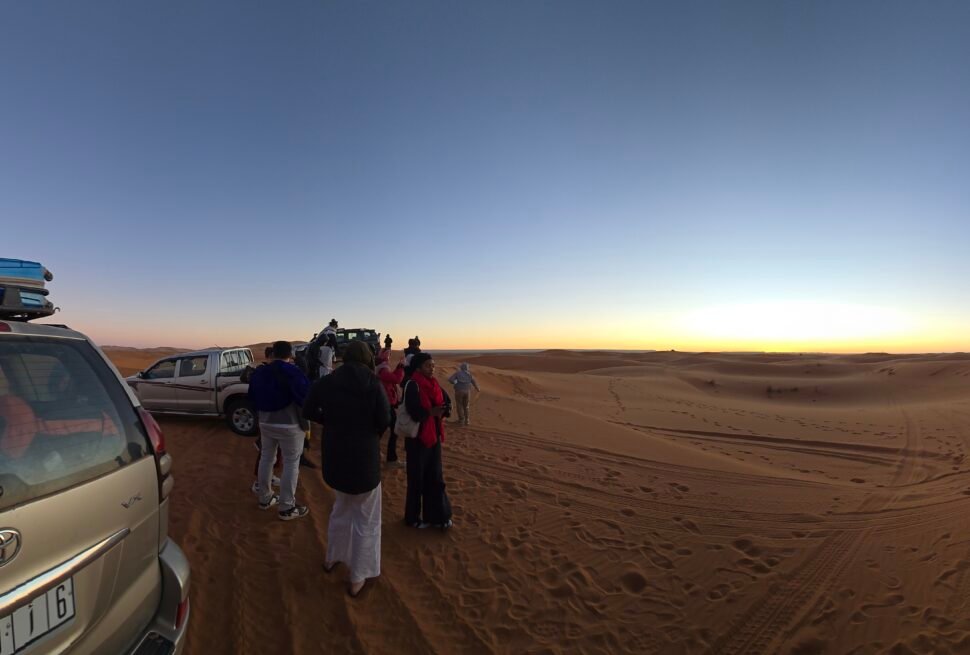
You usually leave the edge of the dunes an hour or so before sunset. The camel trek to camp is short — typically around an hour — and it is slower and more swaying than people expect. Hold the front of the saddle on the way up and down; that is when riders feel least steady.
The light during that hour is the reason the trek is timed this way. Erg Chebbi runs roughly north to south, so the dune faces turn from pale gold to deep orange as the sun drops.
If riding is not for you, say so when you book. On every route we run, the camel trek is the normal way to reach camp but not the only one — a vehicle transfer can be arranged instead, and there is no need to explain yourself.
What the camps are actually like
This is where the honest answer matters, because the word “camp” is doing a lot of work. Broadly there are two tiers in the Moroccan Sahara:
| Standard camp | More comfortable camp | |
|---|---|---|
| Tent | Canvas or wool, mattress on a rug, heavy blankets | Larger tent, proper bed, rugs, furniture |
| Bathroom | Shared, a short walk from the tents | Usually private, attached to the tent |
| Shower | Often cold, sometimes none | Hot water generally available |
| Power | Solar, limited to certain hours | Solar or generator, longer hours |
| Dinner | Communal, shared tables | Communal or private seating |
Neither tier is “the real experience” — that is marketing language. What matters is that you know which one you have booked. Ask directly: is the bathroom private or shared, is there hot water, and how many tents are in the camp. Any operator worth using will answer plainly.
Dinner
Dinner is served after dark in a communal tent, usually a soup followed by a tagine and fruit, with mint tea before and after. It is simple, cooked on site, and there is normally plenty of it. Vegetarian is straightforward if you mention it when booking; stricter diets are possible but genuinely need advance notice, because resupply out here is not quick.
The part nobody photographs well
After dinner someone brings out drums. In most camps the crew plays and sings, guests join in badly, and it goes on for as long as people want it to. It can feel staged in the larger camps and completely unforced in the smaller ones. Either way, it is the part guests mention most often afterwards.
Then people drift away from the fire and look up. There is no settlement close enough to put light into the sky here, and on a moonless night the difference from anywhere you normally stand is hard to overstate. If you want the sky at its darkest, check the moon phase before choosing your dates — a full moon is beautiful on the dunes but washes out the stars.
Sleeping, and the cold
The single most common surprise is the temperature. The Sahara is a wide-range climate, not simply a hot one. Long-term averages at Merzouga put the January night low at around 3.5 °C and the July night low at around 26 °C. In other words:
- December to February: genuinely cold after dark. Camps provide heavy blankets, but bring a warm jacket, socks and a hat. People who feel the cold should add thermal layers.
- March to May, October, November: cool and pleasant. One warm layer is enough.
- June to August: warm enough to sleep outside the tent, which many guests do.
Tents are not soundproof and canvas moves in wind. Light sleepers should bring earplugs. Our Sahara packing list covers the rest.
Washing, power and signal
Be prepared for camp life rather than hotel life:
- Toilets are usually a short walk from your tent in a standard camp. Bring a head-lamp or use your phone torch.
- Showers vary more than anything else. Confirm before booking if this matters to you.
- Electricity is solar in most camps, which means limited hours and limited sockets. Bring a power bank; do not count on charging overnight.
- Mobile signal is patchy in the dunes. Tell people at home they may not hear from you until the following afternoon.
- Dry air is the complaint we hear most. Lip balm and moisturiser earn their place in the bag.
Sunrise, which is the actual highlight
You will be woken early, and it is worth it. Walk up the nearest dune — it is harder than it looks, so allow more time than you think — and watch the light come across the erg. The dunes are at their most sculpted at dawn because the overnight wind has smoothed the ripples and nobody has walked on them yet.
This is the reason a one-night trip is enough but a two-night trip is better. With one night you arrive tired from a long drive and leave at first light. With two, you get a full day in the desert in between.
Who it suits, and who it does not
It suits almost everyone, including families — children generally love the camels and the fire. It is less suitable if you cannot manage uneven ground in the dark, need reliable power for medical equipment, or would be genuinely unhappy with a shared bathroom and no hot shower. In that last case, book a more comfortable camp rather than skipping the night altogether.
Which desert, and how long
The camp experience is broadly similar across Morocco’s desert destinations; what differs is the dunes and the driving:
- 3-day Merzouga tour from Marrakech — the classic. Erg Chebbi, the biggest and most photographed dunes, reached over the Tizi n’Tichka pass with a night in the Dades Valley on the way.
- 3-day Erg Chegaga tour — remote, reached off-road beyond M’Hamid, and much quieter at camp.
- 2-day Zagora tour — the only version that genuinely works in one night, with smaller dunes.
We compare all three honestly in Merzouga vs Zagora vs Erg Chegaga, and our month-by-month guide covers the seasonal side.
Frequently asked questions
Is a desert camp safe?
Yes. Camps are staffed overnight, and the crews live and work in the area. The practical risks are mundane ones — cold at night, walking on uneven sand in the dark, sun exposure the next morning.
Can you shower at a desert camp?
Sometimes, and the water is often cold. This varies more between camps than anything else, so confirm it rather than assuming.
Is one night in the desert enough?
It is enough to see a sunset, a night sky and a sunrise, which is what most people come for. Two nights is noticeably better if your schedule allows it.
What happens if it rains?
Rare but not impossible — Merzouga averages roughly 53 mm across an entire year. Heavy rain can make tracks impassable, in which case the route changes or the night moves to a hotel. Any operator should tell you rather than drive into it.
Arranging it
We run desert nights from Marrakech on fixed and private departures. Tell us your dates, your group and the level of comfort you want and we will say plainly which camp fits — send us a message, or look through the routes on our Morocco tours page.