Fes is the one Moroccan city that rewards patience. Marrakech gives itself up quickly; Fes does not. Its old city, Fes el-Bali, is a walled medina of roughly 280 hectares that UNESCO added to the World Heritage list in 1981, and almost none of it is navigable by car. You walk, you get lost, and the getting lost is the point.
The short answer
Give Fes two full days. One day is enough to see Bab Boujloud, the Bou Inania Madrasa, the Qarawiyyin and the tanneries; the second day is what turns a checklist into a city. If you only have one day, hire a local guide for the morning and keep the afternoon free to wander.
Getting your bearings first
Fes has three distinct parts, and knowing which one you are in saves a lot of confusion:
- Fes el-Bali — the old walled medina, founded under the Idrisid dynasty between roughly 789 and 808, though most of the monuments you will actually visit date from the Marinid period in the 13th and 14th centuries. This is where you will spend most of your time.
- Fes el-Jdid — the “new” city, which is new only by Fes standards: it is 13th-century Marinid. It holds the Mellah, the old Jewish quarter, and the ornate brass gates of the Royal Palace.
- Ville Nouvelle — the French-built modern district, with wide boulevards, banks and the train station. Useful, not atmospheric.
Bab Boujloud, the Blue Gate
Most visitors enter the medina here, and it is the right choice. The gate is tiled blue on the outside and green on the inside, and it funnels you straight onto Talaa Kebira, the main artery running downhill through the old city. Follow it and you will pass most of what is on this list without needing a map.
Bou Inania Madrasa
A few minutes down Talaa Kebira is the finest building in Fes that you can actually go inside. Sultan Abu Inan Faris began it in December 1350 and finished it in 1355, and it is unusual in Morocco for two reasons: it is the only madrasa that also served as a congregational mosque, which is why it has a prominent minaret, and the Friday sermon was once delivered here.
Practical note: the prayer hall itself is off-limits to non-Muslim visitors, but the arched galleries open onto the courtyard, so you can see into it from where you are standing. The carved cedar, stucco and zellij tilework in that courtyard is the reason to come.
The Qarawiyyin
Founded as a mosque in the 9th century and traditionally attributed to Fatima al-Fihri — an attribution some historians now question — the Qarawiyyin is the institution Fes is most famous for. UNESCO describes it as the oldest university in the world, and Guinness World Records lists it as the oldest continuously operating educational institution.
Be realistic about what you can see. The mosque is active, so non-Muslims cannot go in; what you get are glimpses through its doorways, which are still worth seeking out. The attached library is a different matter: a 1940s expansion gave it an entrance outside the mosque, and it is sometimes described as the oldest library still in use anywhere.
Al-Attarine Madrasa
Smaller than Bou Inania and, for some visitors, more beautiful. It sits near the spice and perfume souk that gives it its name, and because it is less busy you can actually stand still and look up at the ceiling. If you are short on time and have to choose one madrasa, choose Bou Inania; if you have an hour spare, add this one.
The Chouara tanneries
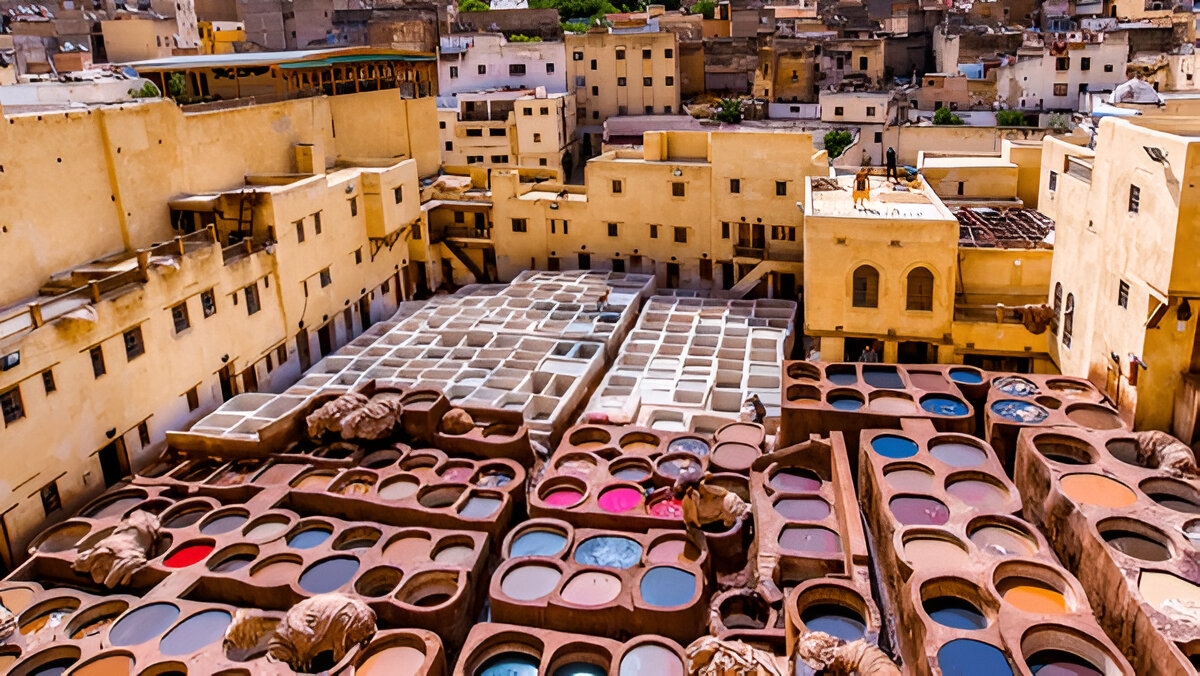
The tanneries are the image of Fes that ends up on postcards: stone vats of white, ochre and deep red dye, worked by hand much as they have been for centuries. You view them from the terraces of the leather shops that surround them, and you will be handed a sprig of mint at the door — hold it under your nose, because the smell is genuinely strong.
Two honest warnings. First, you will be expected to look at leather goods on the way out; that is the arrangement, and there is no obligation to buy. Second, the vats are at their most photogenic in the morning when the light reaches them and the work is underway.
The souks, and getting lost on purpose
Fes el-Bali is a working city, not an open-air museum. The souks are organised loosely by trade — coppersmiths, dyers, carpenters, spice sellers — and the sound changes as you move between them. Set aside an afternoon with nothing planned.
A few things that make it easier:
- The medina slopes. Downhill generally leads deeper in; uphill generally leads back out toward Bab Boujloud.
- Phone navigation works erratically between high walls. Note a landmark near your riad rather than relying on it.
- “Balak!” means a loaded mule is coming through. Step aside promptly.
- A licensed guide for half a day is genuinely useful here in a way it is not in every city — not for the monuments, but for the geography.
Beyond the medina
Walk or take a taxi up to the Borj Nord, the 16th-century fortress on the hill north of the old city, for the view that makes sense of everything you have just walked through — a dense grey-brown sea of rooftops with minarets rising out of it. Best at the end of the afternoon.
In Fes el-Jdid, the Royal Palace gates are worth the detour for the brasswork alone, and the Mellah and its cemetery give you a side of Moroccan history most itineraries skip entirely.
Where Fes fits in a Morocco trip
Fes is rarely a destination on its own. It works best as one end of a route:
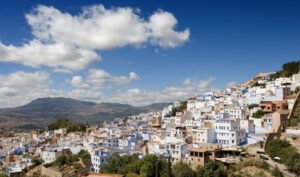
- North to Chefchaouen — the blue city in the Rif, a long but scenic day’s drive, and a natural pairing with Fes.
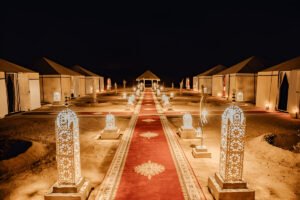
- South to the Sahara — the drive from Fes to Merzouga crosses the Middle Atlas cedar forest and the Ziz valley. Our 5-night Fes to Marrakech tour takes exactly this line, with a night in a desert camp and a day trip to Chefchaouen built in.
- The full loop — if you want Fes, the desert, Chefchaouen, Rabat and Casablanca in one trip, that is what our 9-day Morocco itinerary is for.
If you are weighing up how to cover the distance between the two big cities, our Fes to Marrakech route guide sets out the train, the bus and the overland desert option side by side.
Practical notes
- Mosques: as a general rule in Morocco, active mosques are closed to non-Muslims. Madrasas, the Qarawiyyin library, museums and former mosques converted into monuments are open.
- Dress: Fes is more conservative than Marrakech. Covered shoulders and knees will make your day easier.
- Shoes: the medina is steep, uneven and often wet near the tanneries and dyers. Closed shoes with grip.
- Best months: March to May and September to November. July and August are hot and the medina holds the heat; January nights are cold.
- Cash: most souk stalls are cash-only. There are ATMs near Bab Boujloud and in the Ville Nouvelle.
Frequently asked questions
How many days do you need in Fes?
Two full days is the sweet spot. One day covers the main monuments; the second is what lets the city stop feeling like a maze.
Do you need a guide in Fes?
Not for the monuments, which are straightforward. For the medina itself, a licensed guide for half a day saves real time and frustration, and lets you cover ground you would otherwise miss.
Can you go inside the Qarawiyyin?
Not the mosque, which remains in active use. The library has its own entrance and is accessible, and you can see into the mosque from several doorways.
Is Fes better than Marrakech?
They are different, not ranked. Marrakech is more immediately enjoyable and better connected to the desert and the Atlas. Fes is older, denser and more intact, and the medina is the finer one. Many travellers see both and prefer Fes on reflection.
Planning a trip that includes Fes
We are based in Marrakech and run trips in both directions across the country. If you want Fes combined with the Sahara, Chefchaouen or the Atlas on your own dates, tell us what you have in mind and we will put a route together, or browse everything on our Morocco tours page.