The Marrakech medina is walled, roughly triangular, and easier to read than its reputation suggests. Almost everything a first-time visitor wants to see sits inside those walls, within about a 25-minute walk of the main square. The difficulty is not distance — it is that the alleys do not run straight and the souks are designed to keep you in them.
The short answer
Work from the square outwards. Jemaa el-Fna is your anchor; the Koutoubia minaret is visible from most of the medina and tells you which way is west; the palaces and tombs cluster together in the Kasbah quarter to the south. Two half-days covers it properly.
Jemaa el-Fna
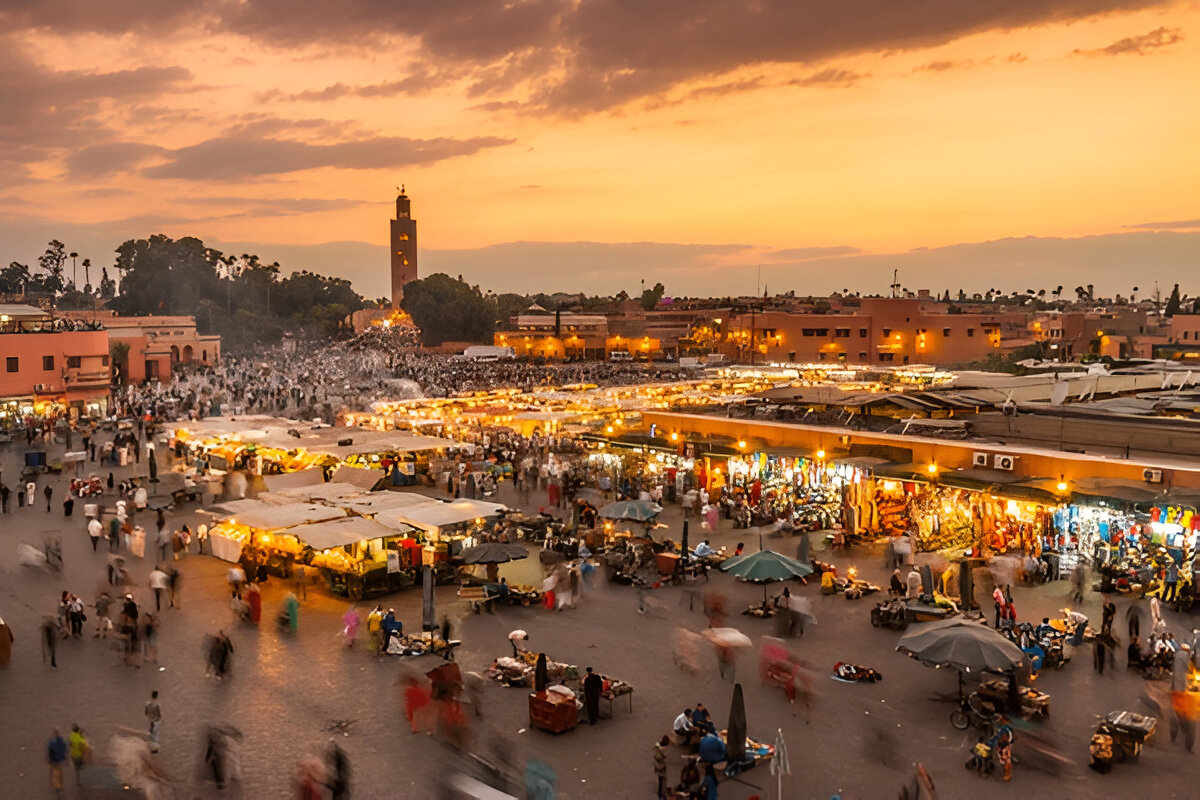
The main square is not a monument, it is a performance that changes through the day, which is why UNESCO proclaimed it a piece of intangible cultural heritage in 2001 and added it to the official list in 2008.
By day it is orange-juice carts, water sellers in fringed hats with brass cups, henna artists and, unfortunately, chained macaques and snake charmers — both species are protected under Moroccan law, and the kindest thing a visitor can do is not pay to photograph them. Through the afternoon the storytellers, musicians and medicine sellers arrive. After dark dozens of food stalls are wheeled in and the crowd peaks.
Practical: the café terraces on the square’s west side are the standard view, and you pay for the view in the price of the drink. Worth it once, at dusk.
Koutoubia Mosque
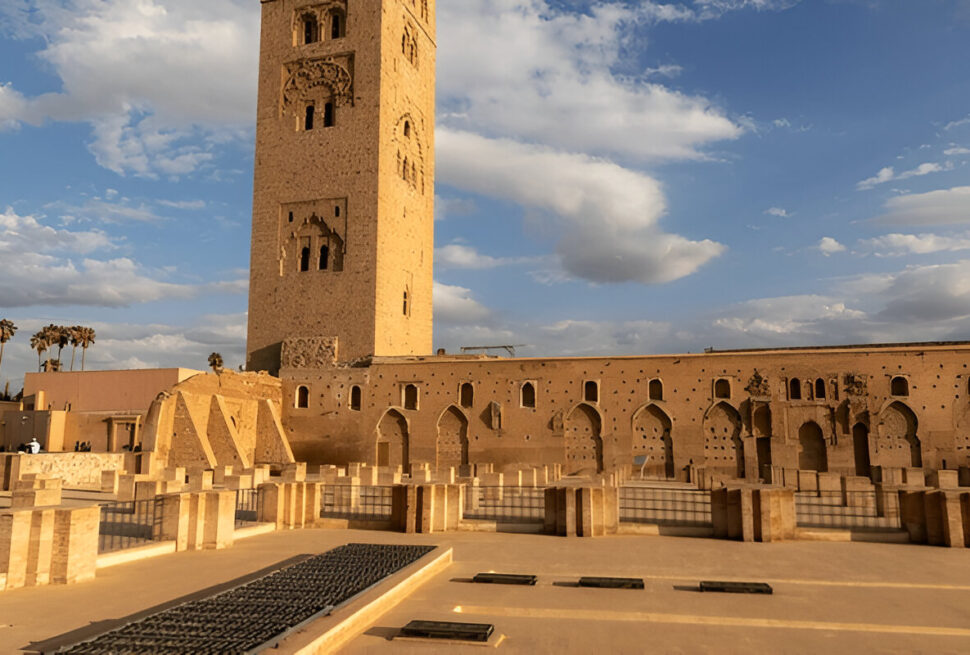
Five minutes west of the square, the Koutoubia is the oldest and most important mosque in Marrakech. The first building was founded in 1147 by the Almohad caliph Abd al-Mu’min, the present mosque was rebuilt around 1158, and the minaret — about 77 metres to the top of its finial — is the tallest structure in the old city and the template for the Giralda in Seville and the Hassan Tower in Rabat.
The name comes from kutubiyyin, “booksellers”: as many as a hundred of them once traded in the souk beside it.
It is an active mosque, so non-Muslims cannot go inside — a rule that applies to working mosques across Morocco, with the notable exception of the Hassan II Mosque in Casablanca. You walk the gardens and look up, which is genuinely enough.
Bahia Palace
The best single building in Marrakech for anyone who likes craftsmanship. Begun in the 1860s by Si Musa, grand vizier to the sultan, and greatly expanded between 1894 and 1900 by his son Ba Ahmed, it runs to roughly 150 rooms across almost two hectares, arranged around courtyards and riad gardens. The Grand Courtyard alone is 50 by 30 metres of marble.
What you are looking at is carved cedar ceilings, painted woodwork and zellij tiling at the height of the craft. It closed briefly after the September 2023 earthquake and reopened that October.
Go early. It is one of the most visited sites in Morocco and the courtyards fill quickly; the first hour after opening is a different experience from midday.
The Saadian Tombs
A short walk further into the Kasbah quarter, and the most atmospheric site in the city. The necropolis dates mainly to the late 16th century: Sultan Abdallah al-Ghalib built the eastern mausoleum between 1557 and 1574 for his father, and Ahmad al-Mansur later added the western one for himself.
The reason to come is the Chamber of the Twelve Columns — al-Mansur’s own mausoleum, a room about ten metres square and twelve high, with twelve Carrara marble columns in groups of three, a red-and-gold cedar ceiling, and marble tombstones on the floor. It is the richest interior in Marrakech.
The tombs were walled up for centuries and only rediscovered in 1917, during the French Protectorate, which is why they survive in the condition they do. The site is small and the queue for that one chamber moves slowly; again, early is better.
El Badi Palace
Next door to the tombs, and the opposite experience: a vast 16th-century palace stripped to its foundations, now open courtyards, sunken gardens and nesting storks on the walls. There is almost nothing left of the decoration, and that is the appeal — the scale is clearer without it. Pair it with the tombs in one visit.
The souks, and how not to lose an afternoon
North of Jemaa el-Fna the souks spread out in a loose grid organised by trade: slippers, leather, lanterns, dyed wool, spices, metalwork. Specific things that help:
- Agree on the idea of a price before you start. Haggling is expected and good-natured, but it is much easier if you have decided privately what the item is worth to you.
- Decline guides who attach themselves to you in the street. Licensed guides can be booked through your riad and are a different proposition.
- The souks close around you. Many stalls shut in the early evening, and the alleys look entirely different when the shutters are down. Note your exit direction while it is still light.
- Motorbikes use these alleys. Walk on the side, not the middle.
- The Koutoubia minaret is your compass. If you can see it, you can find the square.
Two quieter places inside the walls
Le Jardin Secret on Rue Mouassine — a restored riad complex with two formal gardens and a tower you can climb for a rooftop view. It is twenty metres off a busy alley and almost silent.
The Mellah, the old Jewish quarter southeast of the palaces, with its restored synagogue and cemetery. Very few visitors go, and it fills in a part of Marrakech’s history that the souks do not tell.
Just outside the medina
The Majorelle Garden in Guéliz, with its cobalt-blue pavilion and bamboo, is the one site worth leaving the walls for. It is small, heavily visited and ticketed — book ahead and go at opening time.
Practical notes
- Order of visit: Bahia Palace → El Badi → Saadian Tombs in one morning; they are within a few minutes of each other.
- Tickets: bought at each site, usually cash. Opening hours shift with the season and during Ramadan, so check locally rather than relying on a printed schedule.
- Dress: Marrakech is used to visitors, but shoulders and knees covered attracts less attention and is more comfortable in the heat.
- Heat: from June to September the middle of the day is punishing in the medina. Sightsee early, rest at midday, go out again from five.
- Taxis: agree the fare before getting into a petit taxi, or ask for the meter.
When you have seen the city
Most visitors give Marrakech two days and then use it as a base. The obvious next steps are a sunrise hot air balloon flight, which is finished by mid-morning, a sunset camel ride in the Agafay desert 45 minutes from the city, or a full day in the Atlas or on the coast — our guide to day trips from Marrakech sets out the realistic options.
If the Sahara is the reason you came, read what three days from Marrakech actually buys you before committing to an itinerary. And for a shorter list of the city’s headline sights, see our top attractions in Marrakech.
Frequently asked questions
How many days do you need in Marrakech?
Two days for the city itself. Beyond that you are choosing excursions rather than seeing more of Marrakech.
Can you visit the Koutoubia Mosque inside?
No. It is an active mosque and closed to non-Muslims, as working mosques in Morocco generally are. The gardens and the exterior are open to everyone.
Is the Marrakech medina safe to walk at night?
The main routes around Jemaa el-Fna are busy and well used into the night. Deeper residential alleys empty out and are poorly lit, so stick to the arteries after dark and keep your bag in front of you in crowds.
Do you need a guide for the medina?
Not for the monuments. A licensed guide booked through your accommodation is useful for the souks if you want to understand what you are looking at rather than simply shop.
Want it organised?
We are based in Marrakech. If you would rather have the city, the Atlas and the desert arranged around your dates instead of assembling it yourself, tell us what you want to see — or browse the full range on our Morocco tours page.