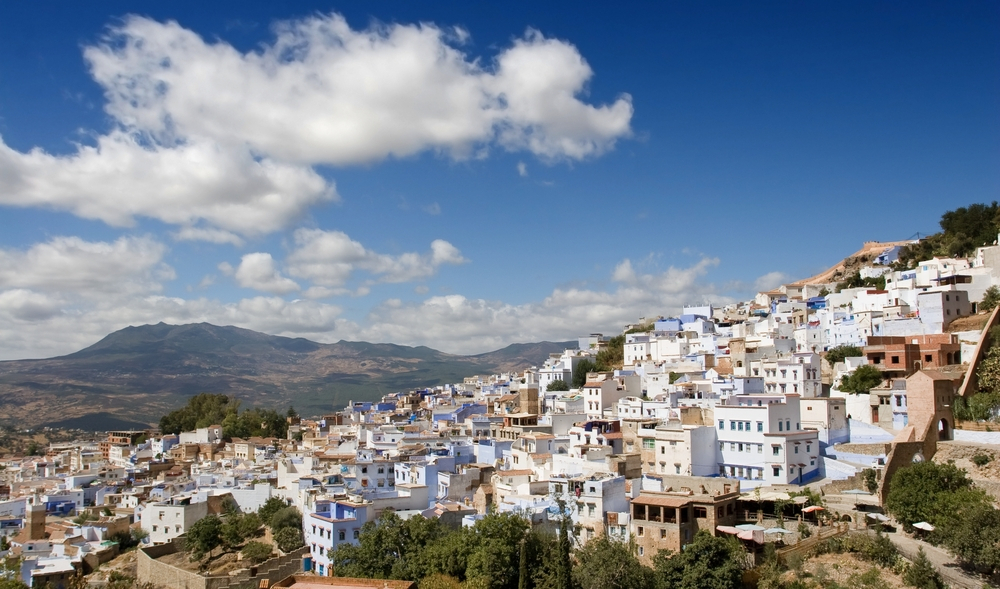
Chefchaouen is the one Moroccan town people recognise before they know its name. It sits in the foothills of the western Rif, a small mountain town of around 46,000 people whose old quarter is painted, wall after wall, in every shade of blue from powder to indigo. It is also three and a half hours from Fes and nowhere near the desert, which makes it a genuine planning decision rather than an easy add-on.
The short answer
Chefchaouen deserves one night, not a day trip, if you can manage it. The medina is small enough to walk in two hours but the town changes completely once the coach parties leave in the late afternoon. If you only have a day, come from Fes and accept that you will see it at its busiest.
Why it is blue — and why nobody agrees
You will be told a single confident explanation, and it is worth knowing that several compete:
- That blue keeps mosquitoes away.
- That it represents the sky and heaven, a prompt toward a spiritual life.
- That it was introduced by Jewish refugees who settled here, for whom blue carried religious significance.
- That the walls were painted blue in the 1970s, on the town’s own initiative, to attract visitors.
Some locals will tell you the last one plainly. The honest position is that the blue as you see it today is relatively recent and maintained deliberately, whatever its origin. That does not make it less striking.
What to actually see
Plaza Uta el-Hammam
The heart of the medina: an open square ringed by the Kasbah, the Great Mosque, a caravanserai and a line of cafés under awnings. It takes its name from a nearby bathhouse. This is where you sit with a mint tea and work out where you are.
The Kasbah
The oldest part of town. Chefchaouen was founded in 1471 by Ali ibn Rashid, originally as a fortress to defend the area against Portuguese incursions, and the Kasbah is that fortress — rammed earth walls now housing a small museum and a walled garden. Climb the tower for a view over the square.
The Spanish Mosque
A disused mosque built by the Spanish in the 1920s on the hillside east of town. Nobody prays here; everybody comes for the view. It is a steady 30–40 minute uphill walk from the medina and it is the single best vantage point over the blue town with the Rif behind it. Go for sunset and bring water.
Ras el-Maa
The spring that originally supplied the town, just outside the old walls on the eastern side. There is an old mill beside it and a bridge, and local women still use the water. Follow the stream uphill and you leave the crowds within minutes.
The medina itself
Smaller and far gentler than Fes or Marrakech. There is little hard selling, the alleys are short, and you cannot get badly lost. The thing to do is simply walk it twice — once in the morning when the light is flat and the blue reads cool, once in the late afternoon when it warms.
Getting there
| From | By road | By bus |
|---|---|---|
| Fes | About 195 km, roughly 3½ hours | CTM, about 4h 40m |
| Tangier | Roughly 2 hours | CTM and Supratours run the route |
| Marrakech | A very long day — not advisable as a single drive | Overnight services exist; most travellers break the journey |
There is no train to Chefchaouen. The nearest stations are Tangier and Fes, and you continue by road from either.
The practical point: Chefchaouen belongs to a northern loop, not a southern one. Pairing it with Fes works. Trying to bolt it onto a Marrakech-and-Sahara trip means two days of driving for one afternoon of blue walls.
How it fits a Morocco itinerary
Two of our routes include it, for different reasons:
- Our 5-night Fes to Marrakech tour uses Chefchaouen as a day trip from Fes on the second day, then turns south to Merzouga. It is the efficient way to see it without rearranging the whole trip.
- Our 9-day Morocco itinerary treats it as a stop in its own right between Fes and Rabat, which is the version that lets you stay the night.
If Fes is new to you, our guide to Fes covers the city at the other end of that drive.
Practical notes
- Best months: April to June and September to October. The Rif gets real rain in winter and the steep alleys turn slippery; August is hot and crowded.
- Altitude and gradient: the town is built on a slope. Everything involves steps. Comfortable shoes matter more here than in most Moroccan towns.
- Photography: ask before photographing people, and expect to be asked for a small payment in a few of the most photographed doorways. Some residents are tired of cameras; a greeting first goes a long way.
- Dress: this is a conservative small town, more so than Marrakech. Covered shoulders and knees.
- Cash: there are ATMs near the main square, but many of the small guesthouses and cafés are cash-only.
- Cannabis: the Rif is a cannabis-growing region and you may be approached. It remains illegal in Morocco. Decline and move on.
Frequently asked questions
Is Chefchaouen worth visiting?
Yes, if it fits your route geographically. It is a genuinely beautiful and unusually relaxed town. No, if adding it means two long driving days carved out of a short trip — in that case see it on a future visit to the north.
How long do you need in Chefchaouen?
One night. The sights take a morning; the atmosphere needs an evening.
Can you do Chefchaouen as a day trip from Fes?
Yes, and plenty of people do — about 3½ hours each way. It is a long day, and you will be there during the busiest hours, but it is a legitimate way to see it if your schedule is fixed.
Is Chefchaouen safe?
It is a quiet town and visitors generally find it among the easiest places in Morocco to walk around. The main annoyance is being offered cannabis, which you should simply refuse.
Planning it
If you want Chefchaouen built into a wider route — with Fes, the Sahara, or on the way between Tangier and Marrakech — tell us your dates and arrival point and we will map something that does not waste days in a vehicle. All our current routes are on the Morocco tours page.